
From Factory Floors to Phone Cameras: The Global History of QR Codes
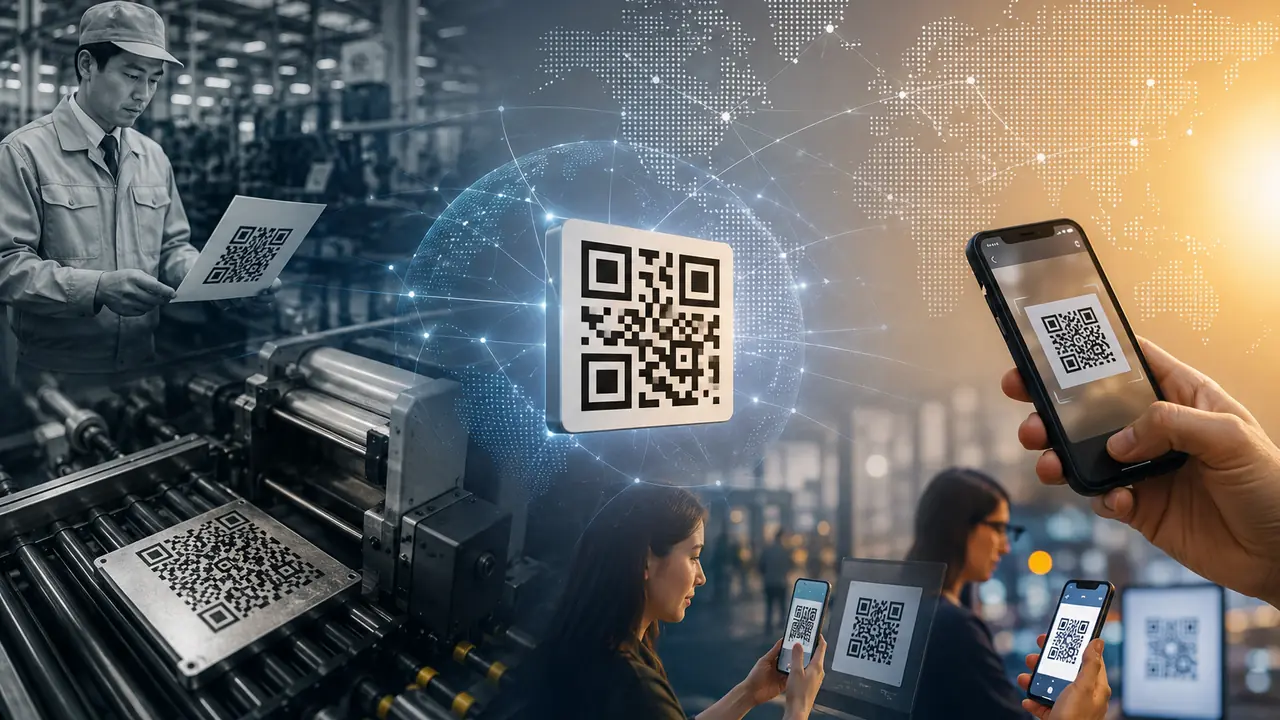
QR codes feel like a very modern invention.
They sit on restaurant tables, coffee cups, event tickets, product packaging, bus stops, business cards, museum signs, delivery boxes, hotel room cards, school worksheets, and sometimes on posters that simply say "Scan me," which is not a strategy, but at least it is trying.
Yet QR codes are not new.
They were created in Japan in the 1990s, long before most people were scanning menus with smartphones. Their first job was not marketing, payments, or customer engagement. It was much more practical: helping manufacturers track parts faster and more accurately.
That is the funny thing about QR codes. They started as an industrial solution for factories. Today, they are one of the easiest ways to connect physical objects to digital experiences. (Curious about the mechanics? See how QR codes actually work.)
From automotive production lines to global packaging, the little square has travelled far.
The Beginning: Japan, 1994
The QR code was developed by DENSO WAVE in Japan and announced in 1994. At the time, manufacturing and logistics teams needed a better way to manage information. Traditional barcodes worked, but they had limits. They could store only a small amount of data and usually had to be scanned from a specific direction.
Factories needed something faster.
They also needed something that could hold more information, scan quickly, and survive real-world conditions such as dirt, damage, and imperfect angles. Factory floors are not exactly gentle environments. They are not spa days for labels.
The answer was the QR code.
"QR" stands for "Quick Response," which describes the original goal clearly: a code that could be read quickly and efficiently. The technology was designed to improve productivity in manufacturing, especially for tracking parts and managing information across production processes.
At first, the QR code was not a consumer tool. It was an operations tool.
No one was scanning it to get a latte discount. Not yet.
The Automotive Roots of QR Codes
QR codes were born from a real industrial need.
DENSO was connected to automotive manufacturing, where tracking many parts accurately was essential. Cars are made from thousands of components, and every part needs to be identified, moved, checked, and assembled correctly.
A faster, more flexible code helped production teams reduce errors and handle information more efficiently.
This is one reason QR codes were designed to be practical rather than pretty. The original goal was not to look good on a poster. It was to work reliably under pressure.
That explains several technical strengths:
- Fast scanning
- High data capacity
- Readability from different angles
- Error correction
- Compact size
- Resistance to dirt and damage
- Suitability for industrial workflows
QR codes were built for work before they were built for marketing. They wore safety boots before they wore brand colors.
The Open Patent Decision
One of the most important reasons QR codes spread globally was DENSO WAVE's decision not to aggressively restrict their use through patent enforcement.
DENSO WAVE held the patent, but the technology was made broadly available, allowing companies and developers to use QR codes without facing the kind of licensing barrier that might have slowed adoption.
This mattered a lot.
If QR codes had been locked behind expensive restrictions, they might have remained a niche industrial tool. Instead, they became easy for software developers, manufacturers, marketers, retailers, educators, transport systems, restaurants, and small businesses to adopt.
Open availability helped QR codes become a standard part of global digital infrastructure.
A licensing fee of even a few cents per print would have killed most of the casual uses that made the format universal. Nobody pays royalties to put a code on a flyer.
The 2000s: QR Codes Enter Consumer Life
In the 2000s, QR codes began moving beyond factories and logistics. They appeared in advertising, magazines, posters, tickets, product labels, and early mobile campaigns.
The idea was exciting: scan a printed code and open a website or digital experience.
The problem was execution.
Many phones did not scan QR codes natively. Users often needed a separate scanning app. Mobile websites were often slow or poorly designed. Some campaigns led to generic homepages, desktop pages, or content that did not reward the scan.
So QR codes had potential, but the user experience was often awkward.
A poster might say "Scan here," but after scanning, the user would land on a page that looked like it had been built for a 2008 office monitor and a very patient person.
Consumers were not always impressed.
Why Early QR Marketing Often Failed
Early QR code marketing had a few common problems:
- Too much friction
Users often needed a scanner app. - Poor mobile websites
Many landing pages were not optimized for phones. - Weak calls to action
"Scan me" did not explain the benefit. - Bad placement
Codes appeared where scanning was difficult or unsafe. - Generic destinations
Many codes opened homepages instead of specific content. - No clear reward
Users scanned and got nothing useful. - Limited analytics
Businesses often did not measure what happened after the scan.
The QR code was not the main problem. The experience around it was.
That is a useful lesson for today too. A QR code can still fail if it leads to a slow, confusing, or irrelevant page.
The Smartphone Shift
QR codes became much more practical when smartphones improved.
Better cameras, faster mobile internet, mobile-friendly websites, and built-in QR scanning changed the experience. Users no longer needed to download a special app just to open a link. They could point the camera and scan - the single biggest point of friction was gone.
Restaurants could use QR menus. Events could use QR tickets. Retailers could connect posters to product pages. Schools could link worksheets to videos. Hotels could guide guests to Wi-Fi and room service. Brands could use packaging as a digital touchpoint.
The QR code did not suddenly become smarter. The world around it became ready. (More on why QR codes became popular again.)
QR Codes and the Contactless Era
The contactless era gave QR codes a major boost.
Restaurants needed digital menus. Events needed safer check-ins. Businesses wanted fewer shared surfaces. Healthcare providers used QR codes for forms and patient information. Customers became more familiar with scanning because it solved real problems.
A restaurant table QR code was not a novelty anymore. It was useful.
The habit spread quickly.
Even after the urgent need for contactless interaction became less intense, many QR use cases remained valuable. Restaurants could update menus instantly. Customers could pay at the table. Hotels could reduce printed room guides. Retailers could collect reviews. Brands could turn packaging into an interactive channel.
The QR code had finally become normal - the kind of thing nobody photographs for LinkedIn anymore, which is usually the moment a technology starts quietly earning its keep.
The Packaging Revolution
Packaging is one of the most important modern chapters in QR code history.
A package used to be limited by physical space. It could show the logo, product name, ingredients, instructions, barcode, claims, and maybe a small brand story if the designer was feeling optimistic.
But consumers now want more information.
They want to know:
- What is inside the product?
- Where did it come from?
- How do I use it?
- Is it authentic?
- Is it recyclable?
- Are there allergens?
- Are there certifications?
- Can I reorder it?
- What do other customers think?
- Does the brand's sustainability claim actually mean anything?
A QR code gives packaging a digital layer.
A jar of honey can point to the apiary it came from. A power tool can open safety videos. A bottle of wine can show vintage notes and food pairings. A box of tea can explain brewing temperatures without cluttering the label.
This is also where the retail industry is heading more broadly. GS1's Sunrise 2027 initiative focuses on helping retailers prepare point-of-sale systems to scan 2D barcodes, including QR-style codes, so products can carry richer data for traceability, transparency, and consumer information.
Packaging is turning into a hybrid: part printed label, part entry point into a product database. (See how QR codes turn packaging into a media channel.)
A Japanese Invention That Became a Global Shortcut
The history of QR codes begins in Japan in 1994, when DENSO WAVE created a faster, more capable code for industrial tracking. What started on factory floors eventually moved into logistics, retail, marketing, smartphones, restaurants, payments, education, public transport, packaging, and global consumer life.
The QR code succeeded because it solved a real problem: how to store and access information quickly in a compact visual format.
Its first audience was manufacturers. Its modern audience is almost everyone with a phone - the same encoding that tracked car parts in Aichi Prefecture now opens lunch menus, boards flights, and settles bar tabs.
Not bad for a little square that started in a factory.
Want one of your own? Make your own QR code in a few clicks - no factory required.